

La Latina Beyond Cava Baja: Quiet Corners and Medieval Secrets

Updated: Sep 23

When Cava Baja Isn't Enough
Ask anyone where to go tapas-hopping in Madrid, and you'll almost certainly get pointed straight to Cava Baja. Fair enough — it's one of the densest concentrations of tapas bars per square meter in the entire city. But on a Friday night, with tables spilling out onto the cobblestones and every doorway backed up three deep, it's easy to forget that Cava Baja is really just one artery of a much larger neighborhood.
La Latina is, in fact, Madrid's oldest urban core. Beneath the pavement of its squares lie the foundations of the old Islamic citadel, and its streets still trace the steep, irregular layout of medieval Madrid — laid out long before the straight Habsburg avenues or the 19th-century expansions that came later.
Just two blocks from Cava Baja, the noise drops away almost instantly. Small squares named after saints appear, along with a 16th-century Plateresque chapel, a stretch of Christian-era city wall tucked between residential courtyards, and a century-old tavern where the fried cod has been served the same way for more than a hundred years.
This guide traces a walk through that parallel version of La Latina — the one that never makes it into Instagram photos with a beer glass in the foreground, but that explains why the neighborhood carries the name it does, and why, long before tapas-hopping existed as we know it, this was already the real Madrid. If you want more background on that medieval layer beneath the tourist crowds, our piece on Mayrit and Habsburg Madrid digs deeper into that hidden history.
💡 Fun Fact: the neighborhood isn't called La Latina by geographic coincidence — it's named after a woman. Beatriz Galindo (1465–1535), born in Salamanca, was the Latin tutor of Queen Isabella the Catholic and her daughters — an exceptional command of Latin for a woman of her era, which earned her the nickname "la Latina." With her fortune she founded hospitals and convents in the area, and one of those hospitals eventually lent its name to the entire neighborhood.
Puerta Cerrada: A Cross, a Motto, and Walls That Speak
The walk begins right where Cava Baja ends, at the Plaza de Puerta Cerrada. The name isn't accidental: one of the gates in Madrid's medieval city wall once stood here, torn down in 1569 because it was getting in the way of city traffic.
At the center of this irregular, pedestrianized square stands a stone cross, whose current version dates to 1783. Several surrounding façades still carry murals painted in 1983 by the artist Alberto Corazón, commissioned to dress up wall surfaces that had been left bare after nearby demolitions.
One of those murals reproduces Madrid's old heraldic motto: "I was built upon water, my walls are made of fire… this is my emblem and my coat of arms." Few tourists stop to read it, but it sums up the city's entire founding mythology in a single line.
If you're chasing bigger, more contemporary street art, Madrid's real hub for that is a bit further east, in Lavapiés — we have a dedicated guide to street art in Lavapiés and La Latina worth checking out if that's what you're after. Within La Latina itself, though, the appeal lies more in these small historical details than in any large-scale mural.
From here, with the Archbishop's Palace peeking into view nearby, the silhouette of the Colegiata de San Isidro already comes into focus. It's a good starting point precisely because, in barely a hundred meters, you've gone from a packed bar-lined street to an almost-empty square where medieval Madrid still feels very present.
How to get there: two minutes on foot from Cava Baja itself, or from the La Latina metro stop (line 5).
What to look for: Corazón's murals on the side façades, and the motto carved in stone.
Best time to visit: morning, when the square is nearly empty and the light pours in fully.
Plaza de la Paja: The Old Market That Became a Garden
Climbing the Costanilla de San Andrés — a steep slope that, according to local tradition, Alfonso VI rode up on horseback in the 11th century after conquering Madrid — leads to the Plaza de la Paja.
It's hard to believe today, with its stone benches and a bronze sculpture of a man reading a newspaper, but between the 13th and 14th centuries this was Madrid's great market square, the true civic center of the town. It lost its central role in the 15th century, when King Juan II promoted the Plaza del Arrabal instead — which would eventually become the Plaza Mayor — but it remained a noble residential area for centuries afterward.
Its irregular, sloped shape isn't a quirk of urban planning; it's the legacy of the old Arroyo de San Pedro, a stream that once ran through here before being diverted and covered over.
Tucked into one side of the square is one of La Latina's best-kept secrets: the Capilla del Obispo, built between 1520 and 1535 on commission from the Vargas family to house the remains of San Isidro Labrador. Its Plateresque façade opens onto an interior that shifts from Gothic to Renaissance style, with the foundations of the old convent visible through a glass floor. It stayed closed to the public for decades and only reopened after a lengthy restoration in 2010.
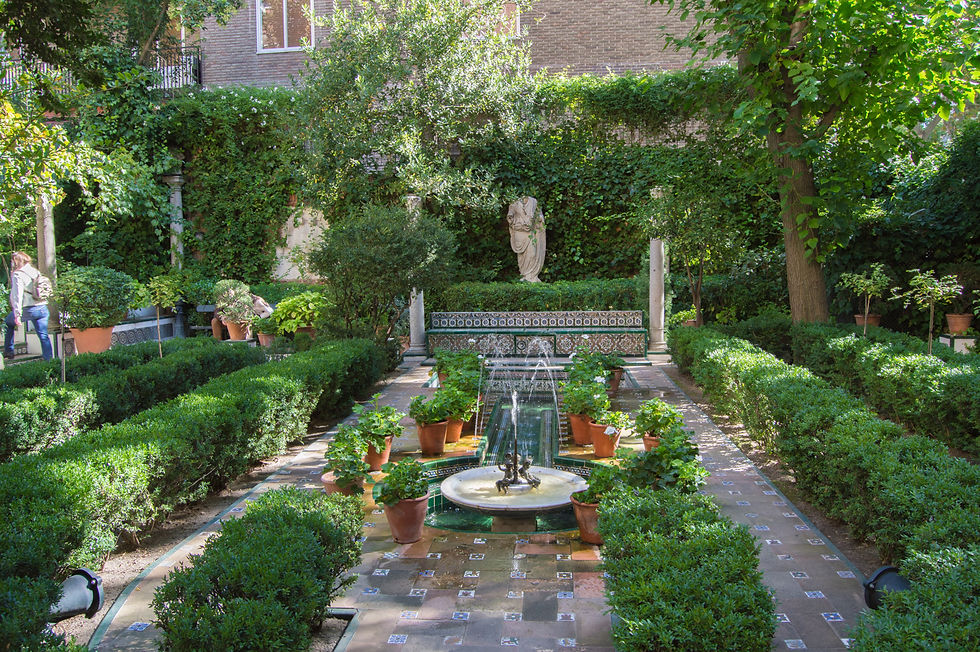
Right next door, on the square's north edge, sits the Jardín del Príncipe de Anglona: an 18th-century aristocratic garden, one of the few in Madrid to survive with its original character intact, and free to enter every day.
📌 Local Tip: the Jardín del Príncipe de Anglona has shaded benches and almost never has a line. It's one of the few spots in central Madrid where you can sit for fifteen minutes without anyone trying to sell you something or snap a souvenir photo of you.
Plaza de San Andrés and Plaza de los Carros: The Museum Nobody Looks For
Right next to Plaza de la Paja sits the Plaza de San Andrés, bordered by the Plaza del Humilladero, the Plaza de los Carros, Calle del Almendro, and the Costanilla de San Pedro. For centuries it served as the cemetery of the San Andrés parish — it's already mentioned in Madrid's town charter of 1202 — and it was pedestrianized in the 1990s.
On one side stands the old Palacio de los Condes de Paredes, home today to the Museo de San Isidro. Los Orígenes de Madrid, dedicated to the city's archaeology and prehistory. Admission is free, and on weekdays it's common to have the place practically to yourself.
Right beside it is the Iglesia de San Andrés, originally intended as the final resting place of San Isidro — which is why the Capilla del Obispo was built next to it for exactly that purpose — though the saint's remains ultimately ended up in the Colegiata instead. If you're visiting Madrid in mid-May, this is also one of the best corners to grasp the devotion behind the San Isidro festivities, which fill the city with chulapos and chulapas every May 15. For the full story of that celebration, see our guide to San Isidro festivities in Madrid.
One step further, the Plaza de los Carros keeps the name it earned back when it served as a stop for carts and transport entering the city. Today it's a quiet, distinctly residential square, with the odd shaded bench, where neighborhood locals walk their dogs without running into a single tour group.
Museo de San Isidro: free admission, ideal for a 30–40 minute stop.
Plaza de San Andrés and its church: the best spot on the route to grasp the whole San Isidro legend at a glance.
Plaza de los Carros: a short stop, perfect for sitting a moment before heading on toward Alamillo.
Plaza del Alamillo and the Old Morería: Madrid's Arab Past
From Plaza de los Carros, wandering west through the side streets leads to one of the most photogenic and least-known corners of the entire center: the tiny Plaza del Alamillo, where four narrow streets meet — Alamillo, Morería, Toro, and Alfonso VI — between façades tilted by centuries of settling.
This is where the alamín once sat, the tribunal that administered justice in Madrid's old Moorish quarter. Some argue instead that the name simply comes from a poplar tree (álamo) toppled by a storm one day. Nearby stands the historic Colegio de San Ildefonso, whose students are the children who sing out the winning numbers of Spain's Christmas Lottery on television every December 22.
This square was once part of what was known as the Morería: the district where, after the Christian conquest of Madrid in 1085 by Alfonso VI, the Muslim population that remained in the city was confined. It was precisely the alarifes — Muslim master builders — who raised some of medieval Madrid's most important infrastructure, including the Plaza de la Cebada itself, the Hospital de la Latina, and the Puente de Segovia.
After the forced-conversion decrees of 1502, the district became an area of "new Christians," and two former mosques were converted into what are today the churches of San Andrés and San Pedro el Viejo — the latter still retains its original Mudéjar tower. Narrow streets like Caños Viejos, Cuesta de los Ciegos, and Calle del Granado still preserve, almost intact, the layout of that original Morería, which was divided at the time into Morería Vieja (near the Campillo de las Vistillas) and Morería Nueva.
💡 Fun Fact: much of the old Morería's urban identity was lost in the mid-19th century, when construction of the Viaducto de Segovia and the widening of Calle de Bailén literally cut the neighborhood in two.
The Hidden Wall on Calle del Almendro
Few tourists — and, honestly, few Madrileños — know that right in the heart of La Latina there survives an original stretch of Madrid's 12th-century Christian city wall. It sits at Calle del Almendro, 15-17, inside a small garden called the Jardín El Almendro, and it's free to visit.
The fragment measures about 16 meters long and 6 meters high, and it once formed part of the defensive wall connecting the old Puerta de Moros with the Puerta Cerrada. It was built after the reign of Alfonso VI and was essentially complete by around 1212, the year of the Battle of Las Navas de Tolosa.
The wall stayed hidden for centuries, absorbed into later buildings, until it turned up unexpectedly in 1967 during demolition work. After restoration, this small garden was created so it could be visited free of charge. A second stretch of the same wall, somewhat more discreet, can be seen from Calle de los Mancebos.
Right next door, at number 13 on the same street, the Taberna Almendro 13 has been holding its ground since 1993 — an Andalusian-style tavern specializing in huevos rotos with ham, fried eggplant with salmorejo, and rosca rolls stuffed with ham. It's the kind of place where eating standing up, elbow braced on the bar, is still the norm.
Christian city wall / Jardín El Almendro: Calle del Almendro, 15-17. Free entry, no fixed published hours — best visited during the day.
Nearest metro: La Latina (line 5), less than five minutes on foot.
Bonus: a second, more discreet stretch of the wall is visible from Calle de los Mancebos.
Quiet Tapas: Bars Away from Cava Baja
You don't have to give up tapas to escape the crowds — you just have to walk two more streets past Cava Baja. Here are a few spots we've verified and confirmed are still open today:
Bar | Address | Specialty |
Taberna Almendro 13 | Calle del Almendro, 13 | Huevos rotos with ham, eggplant with salmorejo |
Alto Bardero | Plaza de Puerta de Moros, 4 | Spanish tortilla pincho (successor to the legendary Juana la Loca) |
El Buo | Calle del Humilladero, 4 | Stuffed Spanish tortillas (ham, cheese, mushroom) |
El Viajero | Plaza de la Cebada, 11 | Rooftop terrace with views of San Francisco el Grande |
Casa Revuelta | Calle de Latoneros, 3 | Battered cod fillet, century-old tavern |
Alto Bardero deserves a special mention: it occupies the old space of the legendary Juana la Loca, which closed in April 2024 after years as a byword for Madrid's best tortilla pincho. Its former cooks, León Bonasso and Pablo Paternostro, reopened the same space a few months later under this new name, reviving the tortilla recipe alongside a broader menu.
📌 Local Tip: at Alto Bardero, the tortilla is limited to about 45 portions a day and typically sells out before 8pm on weekends. If you want to try it, go early or ask on arrival how many are left.
Casa Revuelta, meanwhile, sits right at the neighborhood's northern edge, bordering on the old Habsburg quarter of Madrid — but it's worth the small detour just for its cod fillets, which have been served the exact same way for more than a hundred years, almost always with a line out the door.
And if you're still hungry after all that tapas-hopping, La Latina is also a solid spot to sit down for a full cocido madrileño — you can read the whole history of that dish, and where to find it, in our guide to cocido madrileño.
This same neighborhood also borders El Rastro, Madrid's famous Sunday flea market — more on that below when we talk timing, and you can read its full story in our piece on El Rastro de Madrid.
Las Vistillas and San Francisco el Grande: The Neighborhood's Best Sunset
The walk ends, fittingly, with a view. The Jardines de San Francisco — also known as the Dalieda de San Francisco — surround the Basílica de San Francisco el Grande, an 18th-century church boasting one of the largest domes in Christendom, and housing a painting by Goya inside.
The garden was originally planted with dahlias in 2007, though they were later replaced with rose bushes, better suited to Madrid's dry climate. Among the flowerbeds hides the sculptural group El sueño de San Isidro ("San Isidro's Dream"), and the garden's overlooks open onto views toward the west of the city.
A short climb away sit the Jardines de las Vistillas: an elevated viewpoint with panoramic views of the Almudena Cathedral, the Casa de Campo, and the Campo del Moro. In August it's the traditional stage for Madrid's summer verbenas, complete with chotis dancing, but the rest of the year it's simply one of the best spots in the city to watch the sun go down, beer in hand.
Just below runs the Viaducto de Segovia, built in the 1930s, standing about 23 meters high, with acrylic safety barriers installed in 1998. Director Pedro Almodóvar has used it as a filming location in several movies, including Matador and High Heels (Tacones lejanos).
Best time to go: sunset, avoiding August if you're after peace and quiet (verbena season).
What to bring: something to snack on, and a blanket or cushion if you plan on sitting directly on the grass.
Guaranteed views: Almudena Cathedral, Casa de Campo, Campo del Moro.
Planning the Walk: Route and Practical Tips
All of these spots sit close enough together to cover on foot in a single morning or afternoon, at an easy pace with plenty of tapas stops along the way. Here's a logical north-to-south route:
Stop | What to See | Approx. Time |
1. Plaza de Puerta Cerrada | Stone cross, Alberto Corazón murals | 10 min |
2. Plaza de la Paja | Capilla del Obispo, Jardín del Príncipe de Anglona | 30 min |
3. Plaza de San Andrés | Museo de San Isidro | 30–40 min |
4. Plaza de los Carros | Quiet rest stop | 10 min |
5. Plaza del Alamillo | Wandering through the old Morería | 15 min |
6. Calle del Almendro | Christian city wall, Taberna Almendro 13 | 20 min |
7. Plaza de Puerta de Moros | Tapas at Alto Bardero | 30 min |
8. San Francisco el Grande / Las Vistillas | Gardens and sunset | 30–45 min |
Metro La Latina (line 5): the most practical station, right in the middle of the route.
Metro Puerta de Toledo (line 5): a good option for ending the route toward the south.
Metro Tirso de Molina (line 1): an alternative entry point from the northeast.
Best time to go: weekday mornings or early afternoons, while Cava Baja is still calm. On Sundays the neighborhood fills up with people heading down to El Rastro; if you prefer quiet, go after 3pm, once the market has closed.
El Rastro, while you're at it: this same neighborhood borders Madrid's most famous Sunday flea market, set up every Sunday between 9am and 3pm along the Ribera de Curtidores — a street named after the old leather tanners (curtidores) who once worked here. No extra planning needed: do this route on a Sunday morning and it's right next door.
Frequently Asked Questions About La Latina Beyond Cava Baja
Is it safe to walk these streets? Yes — this is one of the busiest, most well-monitored areas of central Madrid, day or night, though as in any touristy area it's worth keeping an eye on valuables during peak hours.
Is this route suitable for kids? Yes, it's largely flat or gently sloped, with the exception of the Costanilla de San Andrés, and the gardens along the way (Anglona, San Francisco, Vistillas) are great spots for kids to run around for a while.
Do I need to book ahead at these bars? Small spots like Alto Bardero or Taberna Almendro 13 generally don't take reservations, but it's worth arriving early on weekends if you want a spot at the bar.
How long does the whole route take? Counting tapas stops, budget three to four unhurried hours. If you only have a morning, stick to Puerta Cerrada, Plaza de la Paja, and the city wall on Calle del Almendro, and save Las Vistillas for another day when you have more time to catch the sunset.
Is it well connected by public transport? Yes. The entire route moves between the La Latina, Puerta de Toledo, and Tirso de Molina metro stops — all within a ten-minute walk of each other — and several EMT bus lines stop along the neighborhood's edges, on Calle de Toledo and Calle de Bailén. It's worth checking the EMT app for the exact line depending on where you're coming from.
A Neighborhood That Deserves More Than One Visit
Cava Baja will keep being, quite rightly, the best-known postcard image of La Latina. But the neighborhood surrounding it holds a Plateresque chapel tucked into a corner, a fragment of 12th-century wall wedged between residential courtyards, a square that was a marketplace before the Plaza Mayor even existed, and a viewpoint where all of Madrid turns orange at sunset.
Next time you're meeting friends at Cava Baja, show up half an hour early. That's all the margin you need to discover the other La Latina — the quiet one, the medieval one, the one that never makes it into the photos, but that explains where everything else came from.
🚶 Prefer to see it in person? Our City Walking Tour through Habsburg Madrid winds through these very same quiet streets and hidden corners, with a local guide who brings the history behind each square to life.

Comments